Medical and Clinical Microbiology
Pathogens, diagnostics, clinical microbiology, infection biology and emerging infectious diseases.
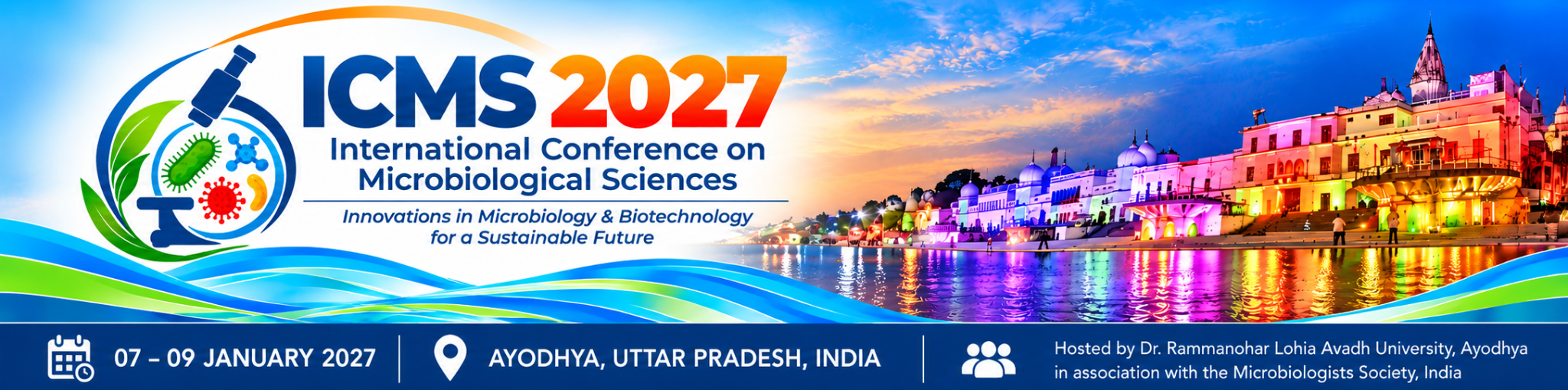
The scientific themes of the International Conference on Microbiological Sciences (ICMS–2027) are designed to highlight recent advances, emerging challenges, and innovative applications of microbiology and biotechnology for a sustainable future. The conference will provide a multidisciplinary platform for researchers, academicians, scientists, industry professionals, and students to exchange knowledge and discuss developments. These themes aim to promote scientific collaboration, encourage innovative research, address global health and environmental challenges, and explore the potential of microbial sciences in sustainable agriculture, biotechnology, disease prevention, and environmental protection. Through interdisciplinary discussions and knowledge sharing, ICMS–2027 seeks to strengthen the role of microbiology and biotechnology in building a healthier, safer, and more sustainable future.
SCIENTIFIC THEMES
Pathogens, diagnostics, clinical microbiology, infection biology and emerging infectious diseases.
AMR surveillance, resistance mechanisms, antimicrobial stewardship and infectious disease research.
Microbial ecology, soil and water microbiology, plant–microbe interactions and sustainable agriculture.
Food safety, probiotics, fermentation, industrial microorganisms, enzymes and microbial products.
Microbial bioprocesses, nanomaterials, bioinnovation, synthetic biology and advanced applications.
Genome analysis, metagenomics, microbial diversity, sequencing, computational biology and data science.
Microbiome structure and function, host–microbe interactions, fermentation and microbial ecology.
Viral biology, emerging viruses, phage biology, phage therapy and virus–host interactions.
Integrated human–animal–environment health, wastewater epidemiology and microbial surveillance.
AI/ML, automation, advanced diagnostics, imaging, biosensors and emerging technologies in microbiology.
HOST INSTITUTION
Dr. Rammanohar Lohia Avadh University (RMLAU), commonly known as Avadh University, is a state university located in Ayodhya, Uttar Pradesh. Established on 4 March 1975 by the Government of Uttar Pradesh as Avadh University, it was renamed in 1993–94 in memory of Dr. Rammanohar Lohia, a noted socio-economic ideologue and freedom fighter.
The university has grown into a major higher-education institution, currently serving about 5 lakh regular and private students through nine residential postgraduate departments, an on-campus Institute of Engineering & Technology, and over 600 affiliated colleges across multiple districts in the Avadh region. Spread across 112.24 acres, the campus houses 23 academic and administrative buildings, including the central library, Swami Vivekananda auditorium, examination centre, IT centre, hostels, and specialized departmental facilities.
RMLAU offers a diverse range of undergraduate and postgraduate programs in engineering, science, humanities, management, biotechnology, mass communication, and more, supported by departments such as Physics & Electronics, Mathematics & Statistics, Biochemistry, Microbiology, Environmental Sciences, and Economics & Rural Development. The university is affiliated with the UGC and holds a NAAC B accreditation, reflecting its commitment to academic quality and regional educational development.
With its motto “Dedicated to Truth”, RMLAU continues to advance research, professional education, and cultural integration through initiatives like the Sardar Patel Centre for National Integration, established in 2020 to promote interdisciplinary studies in governance, strategic affairs, and international relations.
For more details: rmlau.ac.in
CONFERENCE ASSOCIATION
The Microbiologists Society, India (MBSI) is a national scientific organization founded in 1996 that advances microbiology through education, research, outreach, and nationwide student engagement.
Dr. Arvind M. Deshmukh, a distinguished microbiologist with over 37 years of teaching and research experience, founded MBSI in 1996. He previously served as Professor and Head of Microbiology at Dr. Babasaheb Ambedkar Marathwada University’s Osmanabad campus.
Under his leadership, the society has grown into one of India’s active microbiology networks, organizing state, national, and international programs across India, Sri Lanka, Bhutan, Dubai, Mauritius, Bangladesh, Nepal, Maldives, and the USA.
For more details: microbiosociety.com